Fixing SEO Mistakes Should be a Priority for all Businesses
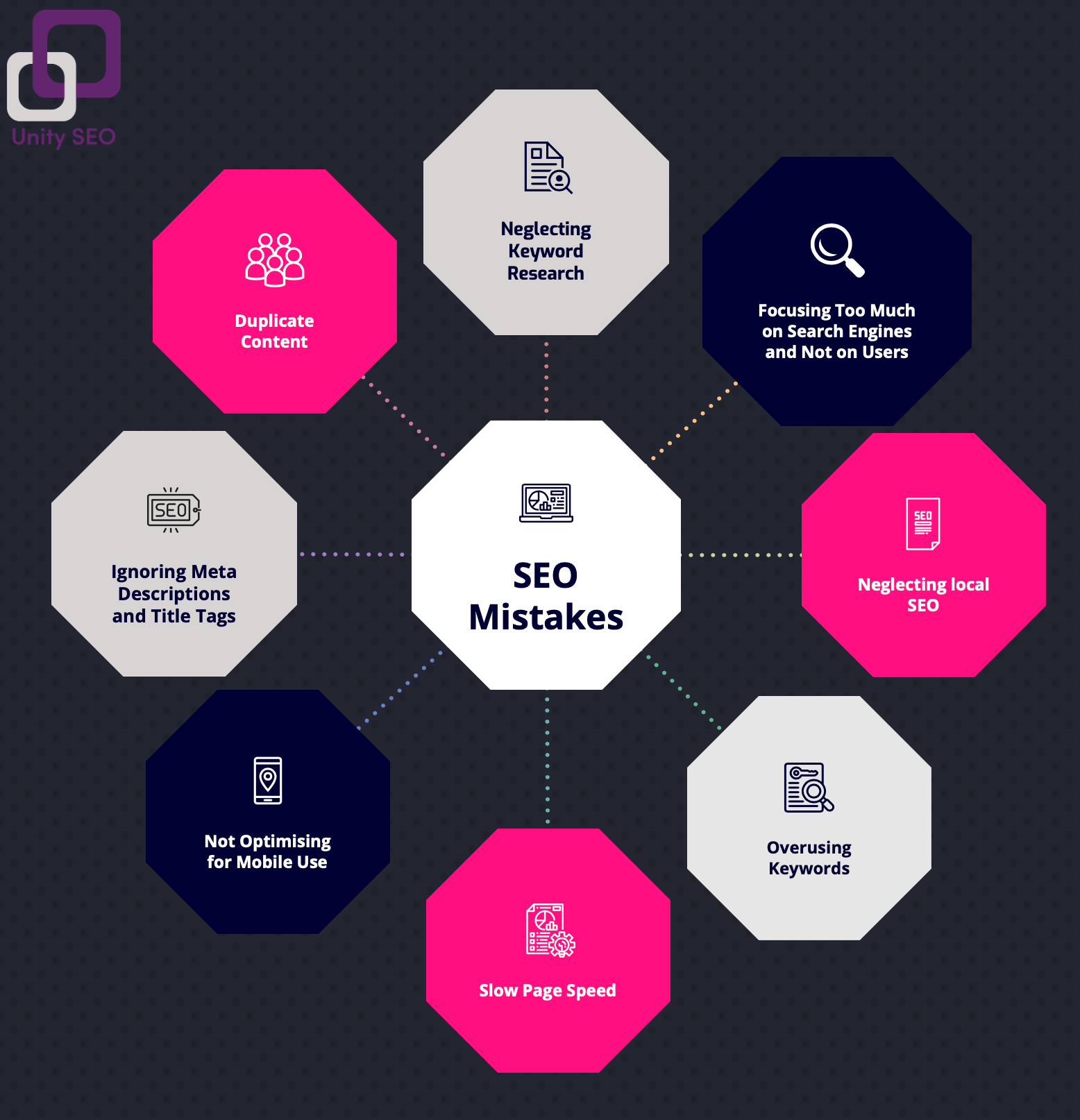
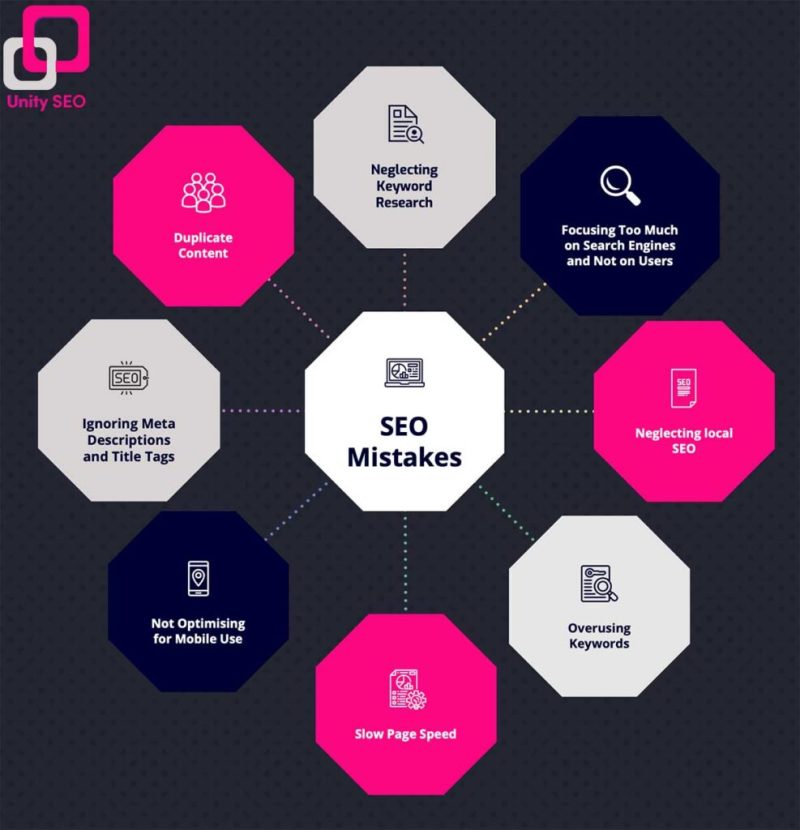
While plenty of online resources are available to help with SEO practices and strategies, avoiding the usual mistakes that can harm your efforts is crucial. This article will address the most common SEO errors and provide solutions to correct them.
The Importance of Fixing SEO Mistakes
The success of any website heavily relies on SEO. It enables potential clients, customers, and readers to locate your website, ultimately driving traffic and revenue. Poor SEO will result in lower rankings on search engines, leading to fewer visitors. This can harm your business or personal brand and result in lost revenue. Therefore, it is vital to recognise and rectify any SEO errors you may be making and optimise your website accordingly.
Neglecting Keyword Research
A common mistake that businesses make with SEO is not doing proper keyword research. Conducting thorough keyword research before optimising any website is crucial to avoid this mistake. To improve online search results, it is important to identify the specific words and phrases people use when searching for information. By finding these keywords, you can optimise your website’s content and meta descriptions to ensure it appears in relevant search results.
You can use keyword tools to identify your industry’s most relevant and popular keywords. Furthermore, it is worthwhile to analyse your competitor’s websites to determine what keywords they use and the traffic they get.
Focusing Too Much on Search Engines and Not on Users
Many businesses focus on search engines rather than ensuring users have a great experience. While it’s important to optimise your website for search engines, it’s equally important to ensure that it is easy to use and offers valuable information. To avoid this mistake, ensure your website is easy to navigate, provides valuable content, and is visually appealing.
Ignoring Meta Descriptions and Title Tags
Meta descriptions and title tags are important SEO elements businesses often ignore. Title tags are HTML elements that specify the title of a webpage. At the same time, meta descriptions briefly summarise the page’s content.
Ignoring meta descriptions and title tags can lower click-through rates and search engine rankings. To avoid this mistake, ensure your title tags and meta descriptions are optimised with relevant keywords and provide an accurate description of the page’s content.
Neglecting local SEO
Neglecting local SEO can harm a business’s success and growth. Here are two key reasons why overlooking local SEO can be bad for business:
Missed Opportunities
Local SEO helps businesses connect with potential customers in their specific geographic area. By paying attention to local SEO, companies miss out on valuable opportunities to reach local consumers actively looking for products or services in their vicinity. Local search queries often carry a higher intent to purchase, making them highly valuable for businesses. When a business fails to optimise its online presence for local search, it becomes less visible to these potential customers, leading to missed opportunities for engagement, conversions, and revenue.
Competitive Disadvantage
Ranking online is challenging, and businesses face fierce competition, especially in local markets. Neglecting local SEO puts a business at a significant disadvantage against competitors actively investing in optimising their online presence for local search. When competitors outrank a business in local search results, they capture the attention of potential customers, leaving the neglected company struggling to gain visibility and traction. As a result, the business may lose market share, credibility, and potential customers to competitors with a more robust local SEO strategy.

Overusing Keywords
It’s crucial to use appropriate keywords in your website’s content to improve its search engine rankings. However, stuffing too many keywords can have the opposite effect and harm your website’s rankings. This can also result in a poor user experience. To prevent this from happening, write content tailored to your audience’s interests and needs instead of solely focusing on search engines. Use keywords naturally and sparingly, and strive to create valuable and engaging content.
Slow Page Speed
Is your website set up for fast page loading speeds to improve the user experience? You can check this via the Page Speed Insights on Google Search console. Optimising your website for rapid loading times is imperative to ensure a satisfactory user experience and retain a favourable position on search engines. Slow page loading times equate to a poor user experience which can deter your potential customers. If your site loads slowly, visitors will quickly become frustrated and seek the products and services elsewhere. Moreover, search engines consider page speed a significant part of determining the quality of user experience on a website. Therefore, monitoring and improving your website’s load time is essential.
To improve your website’s page speed, you can start by compressing images, minimising HTTP requests, and reducing server response time. It is also worth deleting any unused plugins. By implementing these techniques, you can enhance your website’s performance and improve user engagement, leading to higher search engine rankings and better results for your business. Furthermore, utilising a content delivery network (CDN) for more efficient content delivery may benefit users worldwide.
Not Optimising for Featured Snippets
Featured snippets are short boxes at the top of specific search results, giving a brief and direct response to a search enquiry. Optimising your website for featured snippets can help you attract more traffic and establish your brand as an authority in your industry.
To optimise for featured snippets, focus on providing concise and informative answers to common search queries. Use headers and lists to organise your content, and include structured data markup to help search engines understand the content on your website.
Ignoring Link Building
Link building refers to acquiring backlinks from other websites to your own. By obtaining backlinks from reputable websites, you can positively impact your online rankings and increase traffic from potential customers. Ignoring link building can lead to a decrease in search engine ranking and missed chances for referral traffic. To prevent this problem, concentrate on developing connections with other websites in your field and creating first-rate content deserving of being linked to.
Not Analysing Your SEO Performance
One common SEO mistake is failing to monitor and analyse your website’s performance regularly. Consistent monitoring and adjustments are necessary for optimal results as SEO is ongoing. To avoid this mistake, use tools such as Google Analytics and Google Search Console to check your website’s traffic and ranking data regularly. This data lets you identify if your SEO strategy is working. Only some strategies will work; interpreting what is and is not effective is vital to continuous improvement.
Duplicate Content
Duplicate content can have a detrimental impact on your SEO endeavours. When identical or substantially similar content is present across multiple web pages, search engines may struggle to determine which version to prioritise in search results. This can result in a dilution of your website’s visibility and lower rankings. Moreover, search engines strive to provide users with diverse and relevant content, so when they encounter duplicate content, they may choose to exclude or penalise the affected pages, further reducing your organic traffic potential.
Furthermore, duplicate content can hinder the overall user experience. When users encounter identical or nearly identical content on different pages, it can lead to confusion and frustration. They will likely perceive it as a lack of originality or relevance, which can diminish their trust in your website.
The most effective approach to address duplicate content involves the utilisation of 301 redirects, redirecting non-preferred URLs to the preferred ones. However, when it’s necessary to maintain accessibility to visitors for specific URLs, alternative options, such as implementing a canonical URL or a robot’s noindex directive, can be employed instead of redirects.
Your Website is Not Optimised for mobile
The need for optimising your website for mobile phone users cannot be overstated. Because of Google’s mobile-first indexing, your site must work well on mobiles; because it impacts your website rankings. See below:
“Google predominantly uses the mobile version of a site’s content, crawled with the smartphone agent, for indexing and ranking. This is called mobile-first indexing.”
Source: Developer.google.com
This means that when Google indexes and ranks your website content, it prioritises the mobile version of your site.
Ensuring your website is mobile-friendly can be achieved by optimising it for responsive design. Responsive design involves creating and optimising a website to provide the best user experience for different devices. Mobile responsiveness entails adjusting the size of webpage elements and content to fit the device’s screen dimensions while reorganising the content for enhanced user-friendliness as the screen size decreases.

Conclusion and Final Thoughts
SEO is crucial to the success of websites; by fixing common SEO mistakes, you can boost your website’s rankings and attract more visitors. Conduct an SEO audit to identify any issues on your website, and then work on fixing on-page and technical SEO mistakes. Additionally, improve website speed, analyse and fix backlink mistakes, measure success, and track progress. By following these methods, you can fix your website’s SEO mistakes and succeed online.
If you want help with your website, at Unity SEO, we are a well-established SEO consultancy that specialises in getting business seen online. We can help you fix your SEO mistakes, and we work to get your website and content working optimally to increase sales of your services and products. Contact us today to find out how our affordable SEO packages can help your business achieve its digital marketing goals.